I was a bit saddened to see that the 50-year redux of the Woodstock concert succumbed to a variety of setbacks and won’t be held this month. While there was never any realistic expectation that a reiteration of the festival could ever capture the magic of those three days of “peace, love and music”, the level of nostalgia for those days was palpable among many of our generation. I missed the original - at sixteen years of age being just a wee bit too young to appreciate the import of the festival (not to mention getting parental permission to absent myself and travel to New York for three days.) Of course, the later release of the album and movie had a significant impact on my youthful musical education. A group of friends and I once even dismantled and wired two speakers at the local drive-in theater into the speakers of Donny’s van to get the full benefit of watching those rock and roll greats on a gigantic screen combined with a pseudo-stereo listening experience.
I did,
however, get to have a taste of what Woodstock might have been like when I
attended, three years later, Pennsylvania’s attempt to rival the concert at the
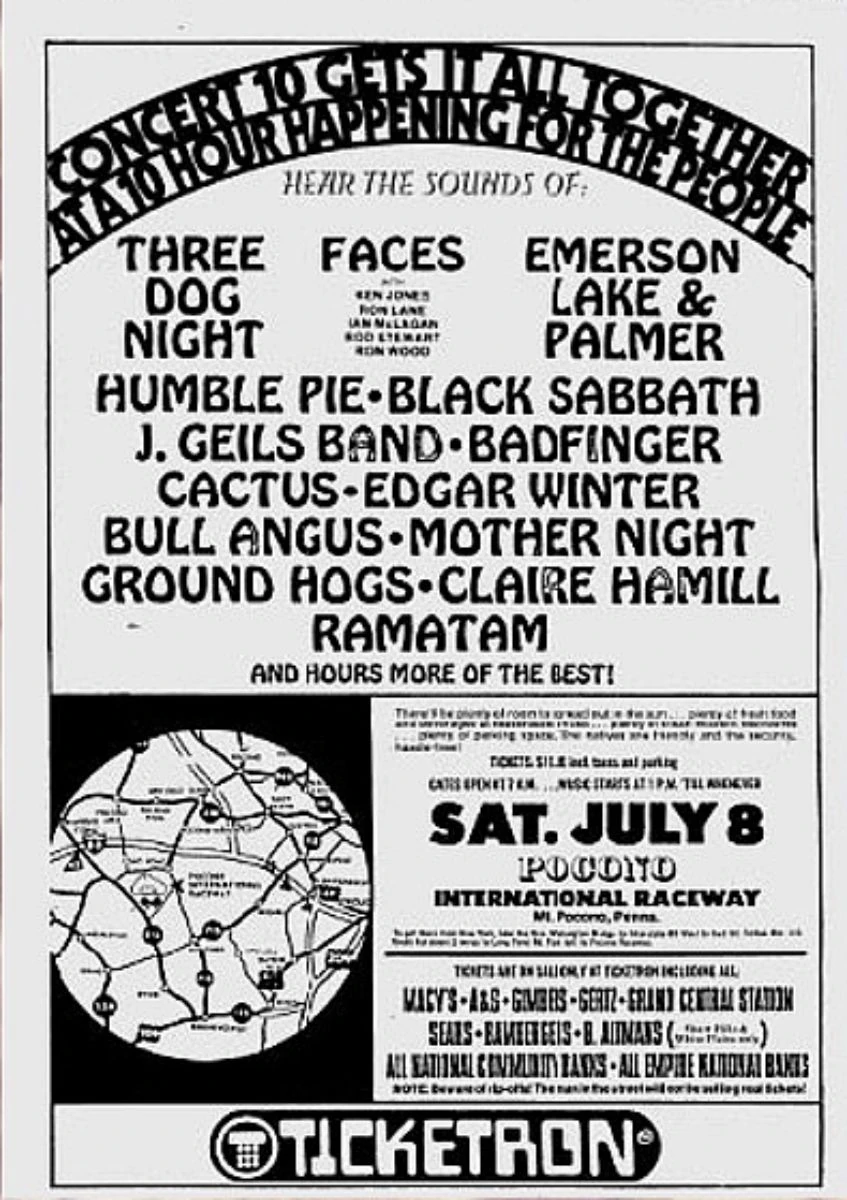
Pocono International Raceway. Put
together in July 1972 by Concert 10, a group of first time promoters who put up
an initial $250,000, the concert fulfilled most expectations, including traffic jams, rain and an incredible lineup of performers.
An
estimated 200,000 of us showed up, paying $11.00 a pop for tickets. I was in the army at the time, stationed at
Fort Meade, Maryland, and drove to Danville the day before, where I met up with
friends to leave early the next day on July 8th, figuring the hour-long
drive east and north to the Poconos should be no problem. It wasn´t until we hit the traffic jam on
Interstate 81. The line of cars soon took up four lanes of the normally
two-lane north bound section of the highway, crawling along at about 5 miles an
hour toward the exit for the Raceway. About
eight miles from the site, concert goers (and the State Police) simply gave up
and turned the interstate into a parking lot.
We locked the car and began the walk to the exit and up a winding country
road to the Raceway.
It was
scheduled to be a one-day concert beginning at 1 pm and going until 11 at
night. It might have been that way if it
hadn´t rained. Downpour, actually:
beginning at three in the afternoon shortly after a couple of the first groups
had played. I wouldn’t have remembered the names of these bands if not for a
Wikipedia lineup: Mother Night, Claire
Hamill and The Groundhogs. I was sitting
with friends about mid-field of the 600 acre infield when the first drops fell,
not far away from a group of leather jacketed bikers had been shooting up Boone’s
Farm wine (Really! Alcohol right to the
bloodstream!) I forget what recreational
goodies we were ingesting – it might have been hash. We were able to partially cover up with some
pieces of discarded cardboard and plastic as the field under and around us
turned to mud. The concert was suspended
until around 6 at night, when the rain stopped and they were able to get the
stage and equipment uncovered.
The music
restarted with Ramatam, a group made up of former members of Iron Butterfly, The Jimi Hendrix Experience and Big
Brother and the Holding Company whose hard rock beat managed to rouse the
drenched crowd from their post-rain stupor.
Because of the hiatus caused by the storm, the one-day concert ended up
going all night through to the next day, finishing at 8:45 a.m. on the 9th .of August.
At 10 pm in
the evening things really got rolling as Edgar Winter took the stage. Highlighted by a prolonged version of Tobacco
Road, his hour-long set was electric as he flew across the stage, his long
white hair shining in the stage lights.
We had been able to build a fire from scraps of wood scavenged from the
outlying areas of the racetrack, so we were able to get a bit dried out and keep
warm as the evening temperatures dropped to around 50 degrees. Small bonfires had cropped up all through the
festival area.
I was much
more capable of spending an entire night awake, on my feet and rocking out in
1972. In reality it was not hard with
the lineup that followed on from Winter’s performance with his White Trash band: Humble Pie and the J.
Geils band, followed on by ELP! I remember shaking my head
in awe as Keith Emerson, coming on stage with Lake and Palmer at 4 a.m., began
throwing a keyboard back and forth across the stage during an improvisation,
eliciting a series of sounds and notes until, after a particularly long flight
through the air it hit the stage and stuck on the beginning chord of Lucky Man, the song which followed. Yes, I was high. But yes, that shit actually happened!
Rod Stewart
played after that. Three Dog Night
closed out the morning, coming on stage at 7:45 to play to the by-then somewhat
thinned-out crowd. Black Sabbath and
Badfinger were scheduled to appear but cancelled at the last minute. But we had made it! Damp, red-eyed, but completely enthralled by
the experience and the music. The walk
back down the hill and south along the interstate to find my car was long and
tiring. The Pocono concert was cited as
being one of the few attempts to come close to successfully recreating the
large venue rock concert in the two years since Woodstock occurred. I like to think that it did. It’s hard to believe that the following day,
August 10th I had to drive back to Maryland and once again put on an
army uniform. I’m not even sure how I
managed to escape military duty for the four days.
I was able
to attend many more concerts, both before and after the Pocono Raceway festival,
but I think this may have been a deciding moment in my hippy, rock and roll
loving life. Who knows? There may be one or two still in the future that
could come up to the standard.
Cool!
ReplyDelete